- Chapter 1: Power Sharing
- Chapter 2: Federalism
- Chapter 3: Gender,religion and caste
- Chapter 4: Democracy And Diversity
- Chapter 5: Political Struggles and Movements
- Chapter 6: Political Parties
- Chapter 7: Outcomes of Democracy
- Chapter 8: Challenges to Democracy
Story of Belgium
Belgium is a small country in Europe with a population of over 1 crore, about half the population of Haryana. Of the country’s total population, 59% speaks Dutch language, 40% of people speak French and the remaining 1% speak German. Look at the map below to know the language variation of Belgium. The minority French-speaking community was rich and powerful, so they got the benefit of economic development and education. This created tensions between the Dutch-speaking and French-speaking communities during the 1950s and 1960s.
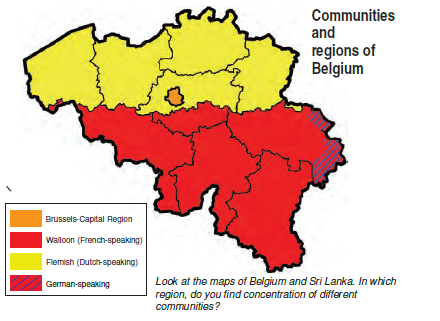
Accommodation in Belgium
In Belgium, the government handled the community difference very well. Between 1970 and 1993, Belgian leaders amended their constitution four times and came up with a new model to run the government.
Here are some of the elements of the Belgian model.
- The Constitution prescribes that the number of Dutch and French-speaking ministers shall be equal in the Central Government. Some special laws require the support of the majority of members from each linguistic group. Thus, no single community can make decisions unilaterally.
- The state governments are not subordinate to the Central Government.
- Brussels has a separate government in which both communities have equal representation.
- Apart from the Central and the State Government, there is a third kind of government. This ‘community government’ is elected by people belonging to one language community – Dutch, French and German-speaking – no matter where they live. This government has the power regarding cultural, educational and language-related issues.
The Belgium model was very complicated but it helped to avoid civic strife between the two major communities.
Story of Sri Lanka
Now, let’s take the situation of another country, Sri Lanka. It is an island nation having a population of 2 crores, about the same as in Haryana. Sri Lanka has a diverse population. The major social groups are the Sinhala-speakers (74%) and the Tamil-speakers (18%). Among Tamils, there are two subgroups, “Sri Lankan Tamils” and “Indian Tamils”. You can see the map below to know the population distribution of different communities of Sri Lanka.
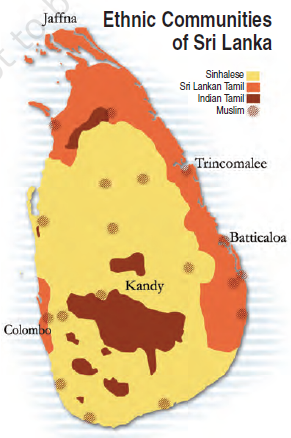
In Sri Lanka, the Sinhala community enjoyed the bigger majority and imposed its will on the entire country.
Majoritarianism in Sri Lanka
Sri Lanka emerged as an independent country in 1948. The Sinhala community was in the majority so they had formed the government. They also followed preferential policies that favoured Sinhala applicants for university positions and government jobs. These measures taken by the government gradually increased the feeling of alienation among the Sri Lankan Tamils. Sri Lankan Tamils felt that constitution and government policies denied them equal political rights, discriminated against them in getting jobs and other opportunities and ignored their interests. Due to this, the relationship between the Sinhala and Tamil communities become poor. Sri Lankan Tamils launched parties and struggles for the recognition of Tamil as an official language, for regional autonomy and equality of opportunity in securing education and jobs. But their demand was repeatedly denied by the government. The distrust between the two communities turned into widespread conflict and turned into a CIVIL WAR. As a result, thousands of people of both the communities have been killed. Many families were forced to leave the country as refugees and many more lost their livelihoods. The civil war ended in 2009 and caused a terrible setback to the social, cultural and economic life of the country.
What have you learned from the Stories of Belgium and Sri Lanka?
- Both countries are democracies but they dealt differently with the concept of power sharing.
- In Belgium, the leaders have realised that the unity of the country is possible only by respecting the feelings and interests of different communities and regions. This resulted in mutually acceptable arrangements for sharing power.
- Sri Lanka shows that, if a majority community wants to force its dominance over others and refuses to share power, it can undermine the unity of the country.
Why is power sharing desirable?
You will find the answer to this question in the points below.
- Power sharing is good because it helps to reduce the possibility of conflict between social groups.
- The second reason is that, a democratic rule involves sharing power with those affected by its exercise, and who have to live with its effects. People have a right to be consulted on how they are to be governed.
Let us call the first set of reasons Prudential and the second moral. The prudential reasons stress that power sharing will bring out better outcomes, whereas the moral reasons emphasise the act of power sharing as valuable.
Form of Power Sharing
Most of you must think that Sharing power = dividing power = weakening the country. A similar thing was believed in the past. It was assumed that all the power of a government must reside in one person or group of persons located at one place. Otherwise, it would be very difficult to make quick decisions and to enforce them. But these notions have changed with the emergence of democracy. In a democracy, people rule themselves through institutions of self-government. Everyone has a voice in the shaping of public policies. Therefore, in a democratic country, political power should be distributed among citizens.
In modern democracies, power sharing can take many forms, as mentioned below:
- Power is shared among different organs of government, such as the legislature, executive and judiciary. This is called horizontal distribution of power because it allows different organs of government placed at the same level to exercise different powers. Such separation ensures that none of the organs can exercise unlimited power. Each organ checks the others. This arrangement is called a system of checks and balances.
- Power can be shared among governments at different levels – a general government for the entire country and governments at the provincial or regional level which is called federal government.
- Power may also be shared among different social groups such as the religious and linguistic groups. ‘Community government’ in Belgium is a good example of this arrangement. This method is used to give minority communities a fair share in power.
Frequently asked Questions on CBSE Class 10 Political Science Notes Chapter 1: Power Sharing
What is ‘Power Sharing’?
Power sharing means the distribution of power among the organs of the government such as the legislature, executive and judiciary.
What are the languages spoken in Belgium?
Belgium is composed of four language areas: the Dutch language area, the French language area, the German language area (9 municipalities in the east of Belgium) and the bilingual Brussels-Capital area.
Where is Sri Lanka located?
Sri Lanka is an island in the Indian Ocean, located to the south of Indian Subcontinent. sprawling over the area of 65,525 Sq. km.

What is federalism?
Federalism is a system of government in which power is divided between a central authority and various constituent units of the country.
A federation has two levels of government. Both these levels of governments enjoy their power independent of the other.
- One is the government for the entire country that is usually responsible for a few subjects of common national interest.
- Governments at the level of provinces or states that look after much of the day-to-day administering of their state.
Difference Between Unitary System and Federal System
| Unitary System |
Federal System |
| There is only one level of government or the
sub-units are subordinate to the Central Government. |
There are two or more levels (or tiers) of government. |
| The Central Government can pass on orders to the provincial or local government. |
The Central Government cannot order the state government to do something. |
| The central government is supreme, and the administrative divisions exercise only powers that the central government has delegated to them. Their powers may be broadened and narrowed by the central government |
State Government has powers of its own for which it is not answerable to the central government. |
Key Features of Federalism
Some of the key features of federalism system are:
- There are two or more levels (or tiers) of government.
- Different tiers of government govern the same citizens, but each tier has its own JURISDICTION in specific matters of legislation, taxation and administration.
- The existence and authority of each tier of government is constitutionally guaranteed.
- The fundamental provisions of the constitution cannot be unilaterally changed by one level of government. Such changes require the consent of both the levels of government.
- Courts have the power to interpret the constitution and the powers of different levels of government.
- Sources of revenue for each level of government are clearly specified to ensure its financial autonomy.
- The federal system has dual objectives: i) To safeguard and promote the unity of the country ii) Accommodate regional diversity.
Different Routes Through Which Federations Can be Formed
Two aspects are crucial for the institutions and practice of federalism: mutual trust between the government of different levels and agreement to live together. There are two kinds of routes through which federations have been formed.
- The first route involves independent States coming together on their own to form a bigger unit. This kind of “coming together” federations is formed in the USA, Switzerland and Australia.
- The second route is that a large country decides to divide its power between the constituent States and the national government. This kind of ‘holding together’ federations is followed in India, Spain and Belgium countries.
What Makes India a Federal Country?
All the features of the federal system apply to the provisions of the Indian Constitution. The Indian Constitution is a three-fold distribution of legislative powers between the Union Government and the State Governments. The 3 lists are mentioned below:
1) Union List: It includes subjects of national importance such as the defence of the country, foreign affairs, banking, communications and currency. The Union Government alone can make laws relating to the subjects mentioned in this list.
2) State List: It contains subjects of State and local importance such as police, trade, commerce, agriculture and irrigation. The State Governments alone can make laws relating to the subjects mentioned in this list.
3) Concurrent List: It includes subjects of common interest to both the Union Government as well as the State Governments. The list includes education, forest, trade unions, marriage, adoption and succession. Both the Union as well as the State Governments can make laws on the subjects mentioned in this list. If their laws conflict with each other, the law made by the Union Government will be considered.
How is Federalism Practised?
The real success of federalism in India is attributed to its nature of democratic politics. Have a look at some of the major ways in which federalism is practised in India.
Linguistic States
The creation of linguistic States was the first and a major test for democratic politics in India. From 1947 to 2017, many old States have vanished and many new States have been created. Areas, boundaries and names of the States have been changed. Some States have been formed of the people who speak the same language. These states are known as Linguistic States.
Language Policy
A second test for Indian federation is the language policy. Hindi was identified as the official language. Besides Hindi, there are 21 other languages recognised as Scheduled Languages by the Constitution. States too have their own official languages and government work takes place in the official language of the concerned State.
Centre-State relations
Restructuring the Centre-State relations is one more way in which federalism has been strengthened in practice. If no single party gets a clear majority in the Lok Sabha, the major national parties can alliance with many parties including several regional parties to form a government at the Centre. This led to a new culture of power sharing and respect for the autonomy of State Governments.
Decentralisation in India
When power is taken away from Central and State governments and given to the local government, it is called decentralisation. The basic idea behind decentralisation is that there are a large number of problems and issues which are best settled at the local level. Local people can also directly participate in the decision making.
A major step towards decentralisation was taken in 1992. The Constitution was amended to make the third-tier of democracy more powerful and effective. Here are the key features of 3-tier democracy:
- It is constitutionally mandatory to hold regular elections to local government bodies.
- Seats are reserved in the elected bodies and the executive heads of these institutions for the Scheduled Castes, Scheduled Tribes and Other Backward Classes.
- At least one-third of all positions are reserved for women.
- State Election Commission has been created in each State to conduct panchayat and municipal elections.
- The State governments are required to share some powers and revenue with local government bodies. The nature of sharing varies from State to State.
Panchayati Raj System
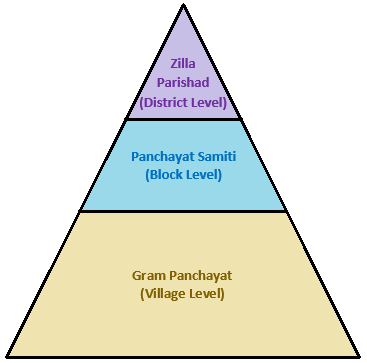
Rural local government is popularly known as Panchayati Raj. Each village, or a group of villages in some States, has a gram panchayat. This is a council consisting of several ward members, often called panch, and a president or sarpanch. They are directly elected by all the adult population living in a village or ward. Gram Panchayat is the decision-making body for the entire village.
The Panchayat works under the overall supervision of the Gram Sabha. All the voters in the village are its members. It has to meet at least twice or thrice in a year to approve the annual budget of the gram panchayat and to review the performance of the Gram Panchayat.
When Gram Panchayat are grouped together, they form a Panchayat Samiti or Block or Mandal. The member of Panchayat Samiti representative are elected by all the Panchayat members in that area.
All the Panchayat Samitis or Mandals in a district together constitute the Zilla (district) Parishad. Members of the Lok Sabha, MLAs of the district, some other officials of other district-level bodies are the members of Zilla Parishad.
Municipalities
As Gram Panchayat is for Rural areas, similarly we have Municipalities for urban areas. Big cities are constituted into Municipal Corporations. Both Municipalities and Municipal Corporations are controlled by elected bodies consisting of people’s representatives. The Municipal Chairperson is the political head of the Municipality. In a Municipal Corporation such an officer is called the Mayor.
This new system of local government is the largest experiment in democracy conducted anywhere in the world. Constitutional status for local government has helped to deepen democracy in our country. It has also increased women’s representation and voice in our democracy.
Federalism is a system of government in which power is divided between a central authority and various constituent units of the country.
What are the sects under ‘Panchayati Raj’?
Panchayati Raj system consists of: Gram Panchayat at the village level, Panchayat Samiti at the block level and Zila Parishad at the district level.
What are the functions of ‘Municipality’?
1. Urban planning including town planning.2. Regulation of land-use and construction of buildings.3. Planning for economic and social development.4. Roads and bridges.5. Water supply for domestic, industrial and commercial purposes.
A Story from Mexico Olympics
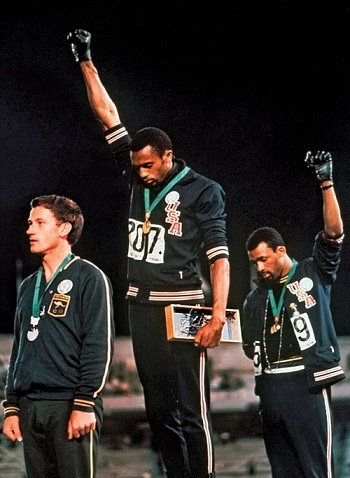
During the Medal Ceremony of the 200 metres race which was held in 1968 Olympics at Mexico City, two African-American athletes Tommie Smith and John Carlos raised a black-gloved fist during the playing of the US national anthem. They had won the gold and bronze medals respectively. With this gesture, they tried to draw international attention to racial discrimination in the United States. The black-gloved and raised clenched fists were meant to symbolise Black Power. The pictures shown below depicts an important landmark in the history of the Civil Rights Movement in the United States.
Differences, Similarities, Divisions
The story from the Mexico Olympics shows an example of social divisions and social inequalities. But in society, there are other forms of social divisions that exist. As you have learned in the previous 2 chapters, regional, linguistic and religious differences have created social divisions.
Origins of Social Differences
The social differences are mostly based on the accident of birth. For example, people around us are male or female, they are tall and short, have different kinds of complexions, or have different physical abilities or disabilities. But some of the differences are based on our choices. For example, some people are atheists i.e they don’t believe in God or any religion. While some people believe in God. There are various other choices such as choosing what to study, which occupation to take up and which games or cultural activities to take part in.
Social differences divide similar people from one another, but they also unite very different people. People belonging to different social groups share differences and similarities cutting across the boundaries of their groups.
Overlapping and Cross-Cutting Differences
Social differences imply a state when people are discriminated or one class/group is given preference over the other, due to the difference in their social, economic or racial inequality. Overlapping and cross-cutting are the two types of social differences.
When one kind of social difference becomes more important than the other and people start feeling that they belong to different communities, this is known as overlapping differences. It results in social division and disintegration. For Eg, in India Dalits face this type of discrimination as they belong to poor families.
If social differences cross-cut one another, it means that groups that share a common interest on one issue are likely to be in different sides on a different issue. For example, the Northern Ireland and the Netherlands both were predominantly Christian but divided between Catholics and Protestants.
Politics of Social Divisions
The combination of politics and social divisions is very dangerous and explosive. Democracy involves competition among various political parties. If they start competing in terms of some existing social divisions, it can make social divisions into political divisions and lead to conflict, violence or even disintegration of a country.
What can be the range of outcomes of politics of social divisions?
In Northern Ireland, the difference between the two major sectors of Christianity i.e 53% of Protestants and 44% of Roman Catholics took the form of politics. The Catholics were represented by Nationalist parties who demanded that Northern Ireland be unified with the Republic of Ireland, a predominantly Catholic country. The Protestants were represented by Unionists who wanted to remain with the UK, which is predominantly Protestant. Later on, it took a drastic form which ended by taking the lives of hundreds of people.
In Yugoslavia, political competition along religious ending ethnic lines led to the disintegration of Yugoslavia into six independent countries. At the same time, every expression of social divisions in politics does not lead to such disasters. But, it affects voting in most countries, especially in India.
Three Determinants
3 Factors are crucial in deciding the outcome of the politics of social divisions:
- The outcome depends on how people perceive their identities. If people see their identities in singular and exclusive terms, it becomes very difficult to solve.
- It depends on how political leaders raise the demands of any community. It is easier to accommodate demands that are within the constitutional framework and are not at the cost of another community.
- It depends on how the government reacts to the demands of different groups.
In a democracy, the political expression of social divisions is very normal and can be healthy. This allows various disadvantaged and marginal social groups to express their grievances and get the government to attend to these.
Mexico is located in the southern portion of North America, between the United States and Central America.
Who were the ‘Dalits’?
In traditional Indian society, the former name for any member of a wide range of low-caste Hindu groups and any person outside the caste system.
Where are the majority of Roman Catholic found?
The country where the membership of the church (Roman Catholic) is the largest percentage of the population is Vatican City at 100%.
In the previous chapter, you have learned that Political expression of social differences is possible and sometimes quite desirable in a democratic system. In Chapter 4 of Class 10 Political Science, you will study 3 kinds of social differences based on gender, religion and caste that can take the form of social divisions and inequalities. In each case, you look at the nature of the division in India and how it gets expressed in politics. So, go through the “CBSE Notes Class 10 Political Science Chapter 4 – Gender, Religion and Caste” and know about all the topics in detail.
Chapter 4 Gender Religion And Caste
Download PDF
Gender and Politics
The gender division tends to be understood as natural and unchangeable. It is not based on biology but on social expectations and stereotypes.
Public/Private Division
The result of this division of labour is that though women constitute half of humanity, their role in public life, especially politics, is minimal in most societies. Earlier, only men were allowed to participate in public affairs, vote and contest for public offices. Gradually the gender issue was raised in politics. It demanded to enhance the political and legal status of women and improve their educational and career opportunities. The movements which were raised by women to get equality in personal and family life are called Feminist movements.
The political expression of gender division and political mobilisation helped to improve women’s role in public life. As India is a male-dominated, PATRIARCHAL society, women face disadvantage, discrimination and oppression in various ways:
- The literacy rate among women is only 54 per cent compared with 76 per cent among men.
- On an average, an Indian woman works one hour more than an average man every day and yet much of her work is not paid. The Equal Remuneration Act, 1976 provides that equal wages should be paid to equal work.
- In India, sex-selective abortion led to a decline in child sex ratio (number of girl children per thousand boys).
- Urban areas have become particularly unsafe for women.
Women’s Political Representation
Issues related to women are not given adequate attention. This has led many feminists and women’s movements to the conclusion that unless women control power, their problems will not get adequate attention. In India, the percentage of elected women members in Lok Sabha touched 12 percent of its total strength for the first time in 2014. Their share in the state assemblies is less than 5 per cent.
One way to solve women’s problem is to have a fair proportion of women in the elected bodies. In Panchayats and Municipalities, one-third of seats in local government bodies are reserved for women. Now there are more than 10 lakh elected women representatives in rural and urban local bodies. Gender division is an example that some form of social division needs to be expressed in politics. This also shows that disadvantaged groups do benefit when social divisions become a political issue.
Religion, Communalism and Politics
Religion
The division based on religious differences are often expressed in the field of politics. In India, there are followers of different religions. People should be able to express in politics their needs, interests and demands as a member of a religious community.
Communalism
The use of religion in politics is called communal politics:
- When beliefs of one religion are presented as superior to those of other religions
- When the demands of one religious group are formed in opposition to another
- When state power is used to establish the domination of one religious group over the rest.
Communalism can take various forms in politics as mentioned below:
- The most common expression of communalism is in everyday beliefs involves religious prejudices, stereotypes of religious communities and belief in the superiority of one’s religion over other religions.
- A communal mind often leads to a quest for political dominance of one’s own religious community.
- Political mobilisation on religious lines involves the use of sacred symbols, religious leaders, emotional appeal and plain fear in order to bring the followers of one religion together in the political arena.
- Sometimes communalism takes its most ugly form of communal violence, riots and massacre. India and Pakistan suffered some of the worst communal riots at the time of the Partition.
Secular State
India is a secular state. Some of the features of India Secular states are:
- There is no official religion for the Indian state.
- The Constitution provides to all individuals and communities freedom to profess, practice and propagate any religion, or not to follow any.
- The Constitution prohibits discrimination on grounds of religion.
- The Constitution allows the state to intervene in the matters of religion in order to ensure equality within religious communities. For example, it bans untouchability.
Caste and Politics
Caste and politics both have some positive and some negative aspects. Let’s look at them:
Caste Inequalities
In most societies, occupations are passed on from one generation to another. Caste system is an extreme form of this. In this system, members of the same caste, the group were supposed to form a social community that practiced the same or similar occupation, married within the caste group and did not eat with members from other caste groups.
With economic development, large scale urbanisation, growth of literacy and education, occupational mobility and the weakening of the position of landlords in the villages, the old notions of Caste Hierarchy are breaking down. The Constitution of India prohibited any caste-based discrimination and laid the foundations of policies to reverse the injustices of the caste system.
Caste in Politics
Caste can take various forms in politics:
- When parties choose their candidate or when governments are formed, political parties usually take care that representatives of different castes and tribes find a place in it.
- Political parties and candidates in elections make appeals to caste sentiment to win the elections.
- To gain support political parties raise caste-based issues during elections to get political support, as ‘one man one vote’ system or adult franchise has made the voter very powerful.
- Political Parties have made people belonging to lower castes conscious about their rights to vote and their powers.
During elections caste matters, but it is not everything. There are many other factors that impact the elections. People’s assessment of the performance of the government and the popularity rating of the leaders are considered during elections. Just have a look at the below points:
- Candidates and parties need to win the confidence of more than one caste and community to win elections.
- No party wins the votes of all the voters of a caste or community.
- Some voters have more than one candidate from their caste while many voters have no candidate from their caste.
- The ruling party and the sitting MP or MLA keep changing whenever fresh elections take place.
Politics in caste
Politics also influence the caste system and caste identities by bringing them into the political arena. Here are a few points that support this;
- Each caste group tries to become bigger by incorporating within it neighbouring castes or sub-castes.
- Various caste groups are formed with other castes or communities and then they enter into a dialogue and negotiation.
- New kinds of caste groups have come up in the political arena like ‘backward’ and ‘forward’ caste groups.
Thus, caste plays different kinds of roles in politics. In some cases, caste division leads to tensions, conflict and even violence.
Yes, gender discrimation does exist in several parts of the world even today.
How can we raise children without gender discrimination?
1. Make children aware about such societal issues 2. Treat a son and a daughter the same way in a household
What role do teachers play to control this indiscrimination?
Teachers should not act biased towards any particular gender. They should award marks to students only based on the performance in the exams
Gender and Politics
The gender division tends to be understood as natural and unchangeable. It is not based on biology but on social expectations and stereotypes.
Public/Private Division
The result of this division of labour is that though women constitute half of humanity, their role in public life, especially politics, is minimal in most societies. Earlier, only men were allowed to participate in public affairs, vote and contest for public offices. Gradually the gender issue was raised in politics. It demanded to enhance the political and legal status of women and improve their educational and career opportunities. The movements which were raised by women to get equality in personal and family life are called Feminist movements.
The political expression of gender division and political mobilisation helped to improve women’s role in public life. As India is a male-dominated, PATRIARCHAL society, women face disadvantage, discrimination and oppression in various ways:
- The literacy rate among women is only 54 per cent compared with 76 per cent among men.
- On an average, an Indian woman works one hour more than an average man every day and yet much of her work is not paid. The Equal Remuneration Act, 1976 provides that equal wages should be paid to equal work.
- In India, sex-selective abortion led to a decline in child sex ratio (number of girl children per thousand boys).
- Urban areas have become particularly unsafe for women.
Women’s Political Representation
Issues related to women are not given adequate attention. This has led many feminists and women’s movements to the conclusion that unless women control power, their problems will not get adequate attention. In India, the percentage of elected women members in Lok Sabha touched 12 percent of its total strength for the first time in 2014. Their share in the state assemblies is less than 5 per cent.
One way to solve women’s problem is to have a fair proportion of women in the elected bodies. In Panchayats and Municipalities, one-third of seats in local government bodies are reserved for women. Now there are more than 10 lakh elected women representatives in rural and urban local bodies. Gender division is an example that some form of social division needs to be expressed in politics. This also shows that disadvantaged groups do benefit when social divisions become a political issue.
Religion, Communalism and Politics
Religion
The division based on religious differences are often expressed in the field of politics. In India, there are followers of different religions. People should be able to express in politics their needs, interests and demands as a member of a religious community.
Communalism
The use of religion in politics is called communal politics:
- When beliefs of one religion are presented as superior to those of other religions
- When the demands of one religious group are formed in opposition to another
- When state power is used to establish the domination of one religious group over the rest.
Communalism can take various forms in politics as mentioned below:
- The most common expression of communalism is in everyday beliefs involves religious prejudices, stereotypes of religious communities and belief in the superiority of one’s religion over other religions.
- A communal mind often leads to a quest for political dominance of one’s own religious community.
- Political mobilisation on religious lines involves the use of sacred symbols, religious leaders, emotional appeal and plain fear in order to bring the followers of one religion together in the political arena.
- Sometimes communalism takes its most ugly form of communal violence, riots and massacre. India and Pakistan suffered some of the worst communal riots at the time of the Partition.
Secular State
India is a secular state. Some of the features of India Secular states are:
- There is no official religion for the Indian state.
- The Constitution provides to all individuals and communities freedom to profess, practice and propagate any religion, or not to follow any.
- The Constitution prohibits discrimination on grounds of religion.
- The Constitution allows the state to intervene in the matters of religion in order to ensure equality within religious communities. For example, it bans untouchability.
Caste and Politics
Caste and politics both have some positive and some negative aspects. Let’s look at them:
Caste Inequalities
In most societies, occupations are passed on from one generation to another. Caste system is an extreme form of this. In this system, members of the same caste, the group were supposed to form a social community that practiced the same or similar occupation, married within the caste group and did not eat with members from other caste groups.
With economic development, large scale urbanisation, growth of literacy and education, occupational mobility and the weakening of the position of landlords in the villages, the old notions of Caste Hierarchy are breaking down. The Constitution of India prohibited any caste-based discrimination and laid the foundations of policies to reverse the injustices of the caste system.
Caste in Politics
Caste can take various forms in politics:
- When parties choose their candidate or when governments are formed, political parties usually take care that representatives of different castes and tribes find a place in it.
- Political parties and candidates in elections make appeals to caste sentiment to win the elections.
- To gain support political parties raise caste-based issues during elections to get political support, as ‘one man one vote’ system or adult franchise has made the voter very powerful.
- Political Parties have made people belonging to lower castes conscious about their rights to vote and their powers.
During elections caste matters, but it is not everything. There are many other factors that impact the elections. People’s assessment of the performance of the government and the popularity rating of the leaders are considered during elections. Just have a look at the below points:
- Candidates and parties need to win the confidence of more than one caste and community to win elections.
- No party wins the votes of all the voters of a caste or community.
- Some voters have more than one candidate from their caste while many voters have no candidate from their caste.
- The ruling party and the sitting MP or MLA keep changing whenever fresh elections take place.
Politics in caste
Politics also influence the caste system and caste identities by bringing them into the political arena. Here are a few points that support this;
- Each caste group tries to become bigger by incorporating within it neighbouring castes or sub-castes.
- Various caste groups are formed with other castes or communities and then they enter into a dialogue and negotiation.
- New kinds of caste groups have come up in the political arena like ‘backward’ and ‘forward’ caste groups.
Thus, caste plays different kinds of roles in politics. In some cases, caste division leads to tensions, conflict and even violence.
Question">Is gender discrimination is still an existing issue?
Yes, gender discrimation does exist in several parts of the world even today.
How can we raise children without gender discrimination?
1. Make children aware about such societal issues 2. Treat a son and a daughter the same way in a household
What role do teachers play to control this indiscrimination?
Teachers should not act biased towards any particular gender. They should award marks to students only based on the performance in the exams
Popular struggles in Nepal and Bolivia
In Chapter 1 of Class 9 Political Science, you have studied the story of the triumph of democracy in Poland. The story reminds you of the role of the people in making Poland a democratic country. Here are 2 more stories through which you get to know how power is exercised in a democracy.
Movement for Democracy in Nepal
Nepal witnessed a popular movement in April 2006, which was aimed at regaining popular control over the government from the king. All the major political parties in the parliament formed a Seven Party Alliance (SPA) and called for a four-day strike in Kathmandu. They demanded;
- Restoration of parliament
- Power to an all-party government
- A new constituent assembly
On 24 April 2006, the king was forced to accept all the three demands. In 2008, the kingship was abolished and Nepal became a federal democratic republic. In 2015, it adopted a new constitution. The struggle of the Nepali people is a source of inspiration to democrats all over the world.
Democratic Politics Bolivia’s Water War
People’s successful struggle against the privatisation of water in Bolivia shows that struggles are necessary for the working of democracy.
Democracy and Popular Struggles
The stories of Nepal and Bolivia were different from each other. The movement in Nepal was to establish democracy, while the struggle in Bolivia involved claims on an elected, democratic government. Both these struggles show their impact at different levels. Despite these differences, both instances involved critical role of political organisations.
Here are some points which demonstrate how democracy has evolved all over the world:
- Democracy evolves through popular struggles.
- Democratic conflict is resolved through mass mobilisation. Sometimes, conflict is resolved by using the existing institutions like the parliament or the judiciary.
- The conflicts and mobilisations are based on new political organisations, which include political parties, pressure groups and movement groups.
Mobilisation and Organisations
In a democracy, different kinds of organisations work behind any big struggle. These organisations play their role in two ways.
- Direct participation in competitive politics which is done by creating parties, contesting elections and forming governments. However, every citizen does not participate so directly, other than through voting.
- There are many indirect ways in which people can get governments to listen to their demands or their points of view. This is done by forming an organisation and undertaking activities to promote the interests or viewpoints of people. Such groups are known as “interest groups or pressure groups”.
Pressure Groups and Movements
Pressure groups are organisations that attempt to influence government policies. These organisations are formed when people with common occupation, interest, aspirations or opinions come together to achieve a common objective.
A Movement attempts to influence politics rather than directly taking part in electoral competition. It’s a small organisation which depends on spontaneous mass participation of people than an interest group.
Eg: Narmada Bachao Andolan, Movement for Right to Information, Anti-liquor Movement, Women’s Movement, Environmental Movement.
Sectional Interest Groups and Public Interest Groups
| Sectional Interest Groups |
Public Interest Group |
| They aim to promote the interests of a particular section or group of society. |
They aim to help groups other than their own members. |
| They represent a section of society. Eg: Trade unions, business associations and professional (lawyers, doctors, teachers, etc.) |
They are also called promotional groups. |
| Their principal concern is the betterment and well-being of their members, not society in general. |
They aim to help groups other than their own members. |
| The members of the organisation may not benefit from the cause that the organisation represents.
Eg: Bolivian organisation, FEDECOR. |
In some instances, the members of a public interest group may undertake activity that benefits them as well as others too.
Eg: BAMCEF (Backward and Minority
Communities Employees Federation) |
How do Pressure Group and Movements influence politics?
They exert influence on politics in a variety of ways:
- They try to gain public support and sympathy for their goals and their activities by carrying out information campaigns, organising meetings, filing petitions, etc.
- They often organise protest activities like strikes or disrupting government programmes.
- Some persons from pressure groups or movement groups may participate in official bodies and committees that offer advice to the government.
The relationship between political parties and pressure groups can take different forms. Some direct and indirect ways are:
- In some cases, the pressure groups are either formed or led by the leaders of political parties or act as extended arms of political parties. For example, most trade unions and students’ organisations in India are either established by or affiliated to one or the other major political parties.
- Sometimes political parties grow out of movements.
For example, when the Assam movement led by students against the ‘foreigners’ came to an end, it led to the formation of the Asom Gana Parishad.
- In most cases, the relationship between parties and interest or movement groups is not so direct. In this case also, the dialogue and negotiation take place as most of the new leaders of political parties come from interest or movement groups.
Is Pressure Group and Movements influence healthy?
Pressure groups and Movements have strengthened democracy. Governments can often come under undue pressure from a small group of rich and powerful people. Public interest groups and Movements perform a useful role in countering this undue influence and reminding the government of the needs and concerns of ordinary citizens. Sectional interest groups also play a valuable role where different groups function actively, no one single group can achieve dominance over society. Thus, the government gets to hear about what different sections of the population want.
What is ‘Mass mobilisation’?
Mass mobilisation is a method through which a centralised political organisation attempts to implement widespread changes in a society.
What is a ‘Pressure Group’?
A pressure group is an organisation that seeks to influence elected officials to take action or make a change on a specific issue.
What is ‘FEDECOR’?
FEDECOR stands for ‘Feracion Departamental Cochabambina de Regantes’. It is a federation of farmers who protested against water privatisation in Bolivia.
Why Do We Need Political Parties?
A Political Party is a group of people who come together to contest elections and hold power in the government. They agree on some policies and programmes for the society with a view to promote the collective good. Parties reflect fundamental political divisions in a society. Thus, a party is known by which part it stands for, which policies it supports and whose interests it upholds. A political party has three components:
- The leaders
- The active members
- The followers
Functions of Political Parties
Political parties fill political offices and exercise political power. Parties do so by performing a series of functions mentioned below:
- Parties contest elections.
- Parties put forward different policies and programmes and the voters choose from them.
- Parties play a decisive role in making laws for a country.
- Parties form and run governments.
- Those parties that lose in the elections play the role of opposition to the parties in power, by voicing different views and criticising the government for its failures or wrong policies.
- Parties shape public opinion.
- Parties provide people access to government machinery and welfare schemes implemented by governments.
The Necessity of Political Parties
We need political parties because they perform all the functions which are mentioned above. Apart from this, political parties help in representing different views on various issues to the government. They bring various representatives together so that a responsible government could be formed. They work as a mechanism to support or restrain the government, make policies, justify or oppose them. Political parties fulfil the needs that every representative government has.
How Many Parties Should We Have?
In a democracy, any group of citizens is free to form a political party. More than 750 parties are registered with the Election Commission of India. But not all these parties are serious contenders in the elections. So the question, then is: how many major or effective parties are good for democracy?
In some countries, only one party is allowed to control and run the government. These are called one-party systems. This system is not considered as a good option for democracy.
In some countries, power usually changes between the two main parties. Such a party system is called a two-party system. Eg: The United States of America and the United Kingdom.
If several parties compete for power, and more than two parties have a reasonable chance of coming to power either on their own strength or in alliance with others, it is called a multiparty system. Eg: India.
When several parties in a multi-party system join hands for the purpose of contesting elections and winning power, it is called an alliance or a front.
National Parties
Every party in the country has to register with the Election Commission. It offers some special facilities for large and established parties. The Election Commission has laid down detailed criteria of the proportion of votes and seats that a party must get in order to be a recognised party.
- A party that secures at least 6% of the total votes in an election to the Legislative Assembly of a State and wins at least 2 seats is recognised as a State Party.
- A party that secures at least 6% of the total votes in Lok Sabha elections or Assembly elections in 4 States and wins at least 4 seats in the Lok Sabha is recognised as a National Party.
Major National Parties in India
There were 7 recognised national parties in the country in 2018. Here are the details of these parties:
1) All India Trinamool Congress (AITC)
- Launched on 1 January 1998 under the leadership of Mamata Banerjee.
- Recognised as a national party in 2016.
- The party’s symbol is flowers and grass.
- Committed to secularism and federalism.
- Has been in power in West Bengal since 2011 and has a presence in Arunachal Pradesh, Manipur and Tripura.
- In the General Elections held in 2014, it got 3.84% votes and won 34 seats, making it the fourth-largest party in the Lok Sabha.
2) Bahujan Samaj Party (BSP):
- Formed in 1984 under the leadership of Kanshi Ram.
- Seeks to represent and secure power for the Bahujan samaj which includes the Dalits, Adivasis, OBCs and religious minorities.
- Stands for the cause of securing the interests and welfare of the Dalits and oppressed people.
- It has its main base in the state of Uttar Pradesh and substantial presence in neighbouring states like Madhya Pradesh, Chhattisgarh, Uttarakhand, Delhi and Punjab.
- Formed government in UP several times by taking the support of different parties at different times.
3) Bharatiya Janata Party (BJP)
- Founded in 1980, formed by Syama Prasad Mukherjee in 1951.
- Wants to build a strong and modern India by drawing inspiration from India’s ancient culture and values and Deendayal Upadhyaya’s ideas of integral humanism and Antyodaya.
- Cultural nationalism (or ‘Hindutva’) is an important element in its conception of Indian nationhood and politics.
- Earlier limited to north and west and to urban areas, the party expanded its support in the south, east, the north-east and to rural areas.
- Emerged as the largest party with 282 members in the 2014 Lok Sabha elections.
4) Communist Party of India (CPI):
- Formed in 1925. Believes in Marxism-Leninism, secularism and democracy.
- Opposed to the forces of secessionism and communalism.
- Accepts parliamentary democracy as a means of promoting the interests of the working class, farmers and the poor.
- Significant presence in the states of Kerala, West Bengal, Punjab, Andhra Pradesh and Tamil Nadu.
- It secured less than 1 per cent votes and 1 seat in the 2014 Lok Sabha elections.
5) Communist Party of India – Marxist (CPI-M):
- Founded in 1964. Believes in Marxism-Leninism. Supports socialism, secularism and democracy and opposes imperialism and communalism.
- Accepts democratic elections as a useful and helpful means for securing the objective of socio-economic justice in India.
- Enjoys strong support in West Bengal, Kerala and Tripura.
- The party was in power in West Bengal without a break for 34 years.
- In the 2014 Lok Sabha elections, it won about 3% of votes and 9 seats.
6) Indian National Congress (INC):
- Popularly known as the Congress Party. One of the oldest parties of the world. Founded in 1885 and has experienced many splits.
- Under the leadership of Jawaharlal Nehru, the party sought to build a modern secular democratic republic in India.
- The ruling party at the centre till 1977 and then from 1980 to 1989. After 1989, its support declined, but it continues to be present throughout the country.
- The party’s main idea is to promote secularism and welfare of weaker sections and minorities.
7) Nationalist Congress Party (NCP):
- Formed in 1999 following a split in the Congress party.
- Supports democracy, Gandhian secularism, equity, social justice and federalism.
- A major party in Maharashtra and has a significant presence in Meghalaya, Manipur and Assam.
- A coalition partner in the state of Maharashtra in alliance with the Congress. Since 2004, a member of the United Progressive Alliance.
State Parties
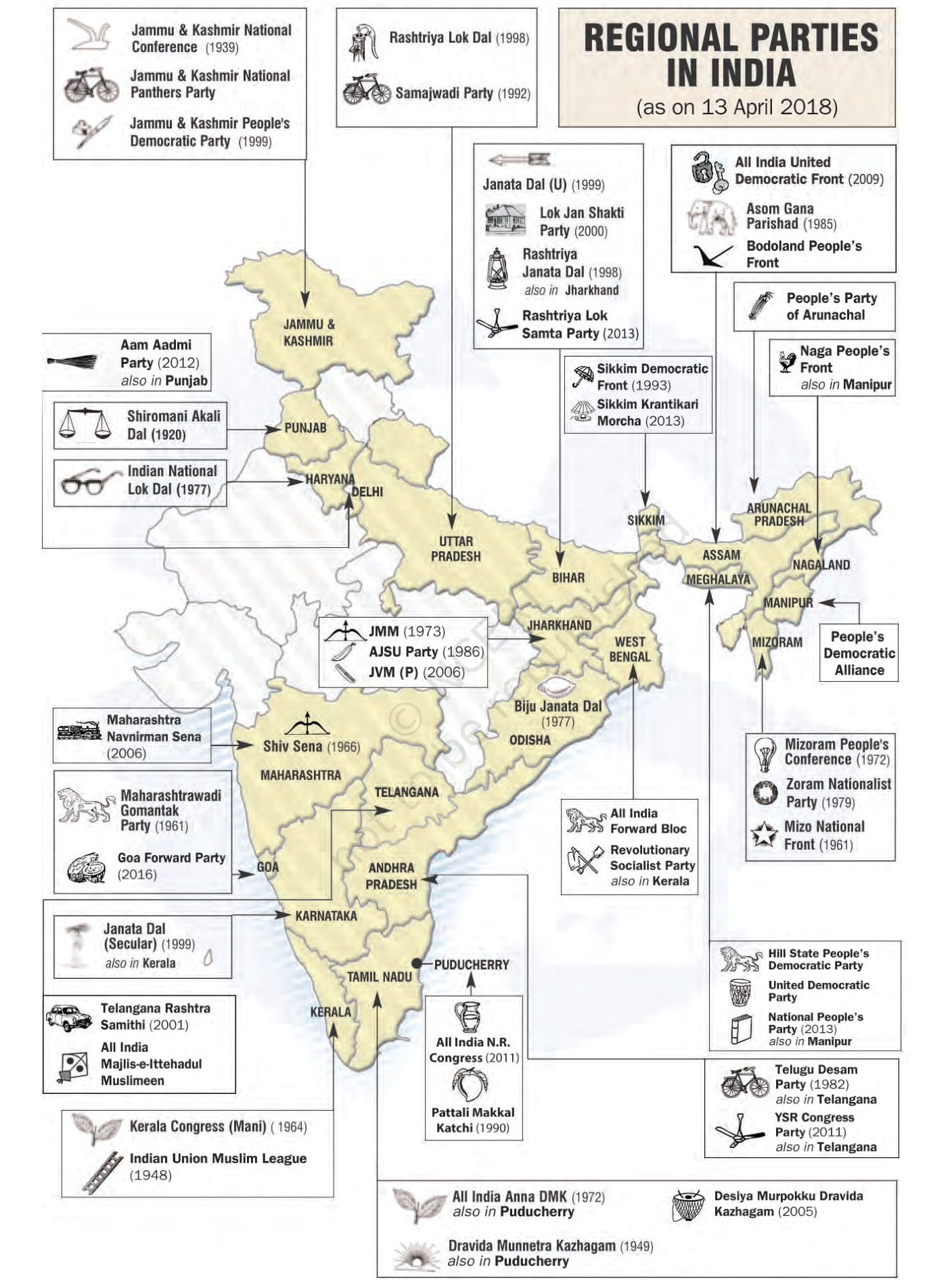
The Election Commission has classified some of the major parties of the country as “State parties”. These are also referred to as regional parties. Some of these parties are:
- Biju Janata Dal
- Sikkim Democratic Front
- Mizo National Front
- Telangana Rashtra Samithi
The Map below shows the Regional Parties in India (as on 13th April 2018):
Challenges to Political Parties
Popular dissatisfaction and criticism have focused on 4 problem areas in the working of political parties. These are:
- Lack of internal democracy within parties. Parties do not keep membership registers, do not hold organisational meetings, and do not conduct internal elections regularly.
- Most political parties do not practice open and transparent procedures for their functioning, so there are very few ways for an ordinary worker to rise to the top in a party. In many parties, the top positions are always controlled by members of one family.
- The third challenge is about the growing role of money and muscle power in parties, especially during elections. Since parties are focused only on winning elections, they tend to use short-cuts to win elections. In some cases, parties support criminals who can win elections.
- People do not find parties to be a meaningful choice for their votes. Sometimes people cannot even elect very different leaders either, because the same set of leaders keep shifting from one party to another.
How can Parties be Reformed?
Have a look at some of the recent efforts and suggestions to reform political parties and its leaders in India. Some efforts are listed below:
- The Constitution was amended to prevent elected MLAs and MPs from changing parties.
- The Supreme Court passed an order to reduce the influence of money and criminals. Now, it is mandatory for every candidate who contests elections to file an AFFIDAVIT giving details of his property and criminal cases pending against him.
- The Election Commission passed an order making it necessary for political parties to hold their organisational elections and file their income tax returns
Besides these, many suggestions are made to reform political parties. These suggestions have not yet been accepted by political parties.
- A law should be made to regulate the internal affairs of political parties.
- It should be made mandatory for political parties to give a minimum number of tickets, about one-third, to women candidates. Similarly, there should be a quota for women in the decision making bodies of the party.
- There should be state funding of elections. The government should give parties money to support their election expenses.
There are two other ways in which political parties can be reformed.
- People can put pressure on political parties. This can be done through petitions, publicity and agitations.
- Political parties can improve if people who want change can join political parties. It is difficult to reform politics if ordinary citizens do not take part in it and simply criticise it from the outside.
- What are the functions of political parties?
1. Contest elections 2. Introduce programmes and policies for welfare of the public 3. Take legislative decisions and execute them legally
How many political parties are there in India?
The Election Commission of India recorded a count of 2858 political parties all over India in September 2021.
What is the minimum age in India to join a political party?
A person should be of a minimum age of 25 years to be a part of any poliical party in india.
How do We Assess Democracy’s Outcomes?
Democracy is a better form of government than dictatorship in the following respects:
- Promotes equality among citizens.
- Enhances the dignity of the individual.
- Improves the quality of decision making.
- Provides a method to resolve conflicts.
- Allows room to correct mistakes.
Democracy Produces Accountable, Responsive and Legitimate Government
People have the right to choose their rulers and they have control over their rulers. Citizens can participate in decision making. Thus, democracy produces a government that is accountable to the citizens, and responsive to the needs and expectations of the citizens.
Democracy ensures that decision making is based on norms and procedures. So, a citizen who wants to know if a decision was taken through the correct procedures can find out this information. Citizens can take part in decision making whenever they want.
A democratic government is the people’s own government. People wish to be ruled by representatives elected by them.
Economic Growth and Development
Economic development depends on several factors: the country’s population size, global situation, cooperation from other countries, economic priorities adopted by the country, etc. There is a significant difference in the rates of economic growth between countries under dictatorship and democracy. So, democracy is preferred as it has several positive outcomes.
Economic Outcomes of Democracy
The following points show the relationship of democracy with economic growth and economic inequalities.
- Dictatorial regime has had a slightly better record of economic growth. But when we compare their record only in poor countries, there is virtually no difference.
- There can be a very high degree of inequalities within democracies.
- There is often inequality of opportunities available to the poorer sections of the society.
Reduction of Inequality and Poverty
All individuals have equal weight in electing representatives. In the process of bringing individuals into the political arena on an equal footing, we find growing economic inequalities.
- A small number of ultra-rich enjoy a highly disproportionate share of wealth and incomes. Their share in the total income of the country has been increasing.
- Those at the bottom strata of the society have very little to depend upon. Their incomes have been declining.
In actual life, democracies do not appear to be very successful in reducing economic inequalities.
Accommodation of Social Diversity
No society can fully and permanently resolve conflicts among different groups. However, we can learn to respect these differences and we can evolve mechanisms to negotiate the differences. Democracy is best suited to produce this outcome. Ability to handle social differences, divisions and conflicts is a plus point of democratic regimes. But democracy must fulfil 2 conditions in order to achieve this outcome:
- The majority always needs to work with the minority so that governments function to represent the general view.
- Rule by majority means that in case of every decision or in case of every election, different persons and groups may and can form a majority.
Dignity and Freedom of the Citizens
Democracy stands much superior to any other form of government in promoting the dignity and freedom of the individual. The passion for respect and freedom are the basis of democracy. Let’s take the case of the dignity of women. The long struggles by women have created some sensitivity that respect and equal treatment of women are necessary ingredients of a democratic society. The same is true of caste inequalities. Democracy in India has strengthened the claims of the disadvantaged and discriminated castes for equal status and equal opportunity.
Most individuals today believe that their vote makes a difference to the way the government is run and to their own self-interest. Democratic examination never gets over. As it passes one test, it produces another test. As people get some benefits of democracy, they ask for more and want to make democracy even better. The fact that people are complaining is itself a testimony to the success of democracy.
How to assess the outcomes of democracy?
Democracy helps in promoting equality among the citizens, improves the dignity of an individual, enhances decision making and gives a solution to solve conflicts.
How democracy offers freedom and dignity among citizens?
Freedom and dignity is the base of democracy. It is superior to any government in promoting freedom and dignity.
How democracy accommodates social diversity?
Democracy accommodates social diversity by making the majority and minority work together, and the rule can be made by any person or group.
Think About the Challenges of Democracy
A challenge is a difficulty that carries within it an opportunity for progress. Different countries face different kinds of challenges.
- At least one-fourth of the globe is still not under a democratic government. These countries face the foundational challenge of making the transition to democracy and then instituting a democratic government.
- Most of the established democracies face the challenge of expansion. This involves applying the basic principle of democratic government across all the regions, different social groups and various institutions. This also means that less and less decisions should remain outside the arena of democratic control. Countries like India and the US face this challenge.
- Deepening of democracy is the challenge faced by every democracy in one form or another. This involves strengthening of the institutions and practices of democracy. This requires an attempt to bring down the control and influence of the rich and powerful people in making governmental decisions.
Thinking about Political Reforms
All the suggestions or proposals about overcoming various challenges to democracy are called ‘democracy reform’ or ‘political reform’. The below-mentioned guidelines will help in devising ways and means for political reforms in India:
- Law has an important role to play in political reform. Carefully devised changes in law can help to discourage wrong political practices and encourage good ones. But legal-constitutional changes by themselves cannot overcome challenges to democracy. Democratic reforms are to be carried out mainly by political activists, parties, movements and politically conscious citizens.
- The best laws are those which empower people to carry out democratic reforms. The Right to Information Act is a good example of a law that empowers the people to find out what is happening in government and act as watchdogs of democracy.
- The main focus of political reforms should be on ways to strengthen democratic practice.
- Any proposal for political reforms should think not only about what is a good solution but also about who will implement it and how.
Redefining Democracy
Democracy is a form of government in which the rulers are elected by the people.
- The rulers elected by the people must take all the major decisions.
- Elections must offer a choice and fair opportunity to the people to change the current rulers.
- This choice and opportunity should be available to all the people on an equal basis.
- The exercise of this choice must lead to a government limited by basic rules of the constitution and citizens’ rights.
Here we have summarised the points that you have learned in democratic government and politics.
- You have learned the democratic rights at length and understood that these rights are not limited to the right to vote, stand in elections and form political organisations. Also, you have read about some social and economic rights that democracy should offer to its citizens.
- You get to know that power-sharing is the spirit of democracy and how power-sharing between governments and social groups is necessary in a democracy.
- You saw how democracy cannot be the brute rule of the majority and how a respect for the minority voice is necessary for democracy.
- You have learned how eliminating discrimination based on caste, religion and gender is important in a democracy.
- Finally, in this chapter, you get to know about the outcomes of democracy.
What is a ‘Democracy’?
The word democracy most often refers to a form of government in which people choose leaders by voting.
What is ‘Bonded labour’?
Bonded labor, also known as debt bondage and peonage, happens when people give themselves into slavery as security against a loan.
What is the meaning of ‘Fundamental right’?
Fundamental rights are a group of rights that have been recognised by the Supreme Court as requiring a high degree of protection from government encroachment.